
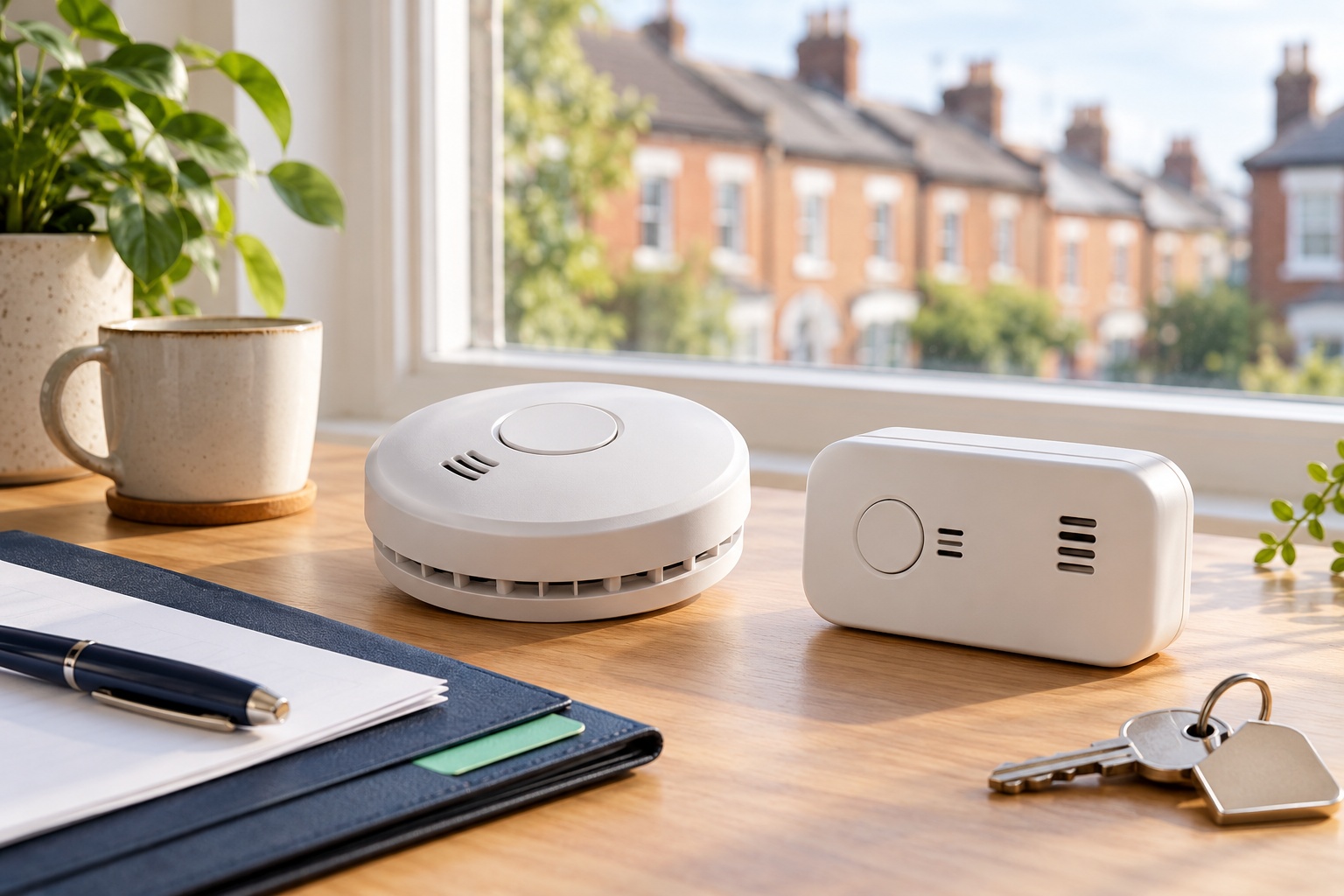
Smoke and carbon monoxide alarms need attention at different points in a tenancy. For landlords managing their own properties, it helps to know which alarms are needed, arrange the right checks and have a clear way to respond when a tenant reports a problem.
A useful approach is to keep one alarm record for each property, showing the devices installed, their locations, checks completed and any repairs still needing attention.
Good records support the work, but the alarms themselves must be installed, checked and dealt with when faulty. The following summary covers rented homes within England’s alarm regulations.
Quick answer: For covered rented homes in England, landlords must provide a smoke alarm on every storey with living accommodation and a carbon monoxide alarm in each room used as living accommodation containing a fixed combustion appliance, excluding gas cookers. Required alarms must be checked on the first day of a new tenancy. Following a tenant’s report, landlords must investigate and repair or replace faulty required alarms as soon as reasonably practicable.
Applies to England. Sources checked: 8 October 2026. See the government’s alarm guidance and the 2022 amendment regulations, regulation 5. Different rules apply elsewhere in the UK.
Which rented homes does this guidance cover?
This guide focuses on ordinary private rentals in England where the tenant pays rent and occupies the home as their only or main residence. The regulations contain exclusions, including certain arrangements where the occupier shares accommodation with a resident landlord. Check the official scope and exclusions if your letting is unusual.
If your property requires an HMO or selective licence, check the licensing route and your actual licence conditions. An HMO is a house in multiple occupation: broadly, a home shared by people from more than one household. Properties requiring licensing are dealt with through separate provisions; this does not mean they need no alarms. The 2015 regulations, regulations 2 and 15, and the 2022 licensing amendment, regulation 13, explain that distinction.
These basic alarm rules are not a complete fire-safety assessment for a building.
Where are smoke and carbon monoxide alarms needed?
For homes covered by the regulations, the minimum smoke-alarm requirement is at least one on each storey containing a room used wholly or partly as living accommodation. Bathrooms and toilets count as living accommodation for this purpose.
Carbon monoxide (CO) alarms follow a room-based rule. A required CO alarm belongs in each room used wholly or partly as living accommodation that contains a fixed combustion appliance, other than a gas cooker. See regulation 4 of the 2015 regulations, read with regulation 5 of the 2022 amendments.
A fixed combustion appliance is fixed equipment that burns fuel to produce heat. Examples include gas or oil boilers and wood-burning stoves. The government guidance explains the definition and gas-cooker exception.
| Situation in a covered home | What to check |
|---|---|
| A two-storey house with living accommodation on both floors | Provide at least one smoke alarm on each storey. |
| A kitchen containing a gas boiler | A CO alarm is required in that room. |
| A living room containing a wood-burning stove | A CO alarm is required in that room. |
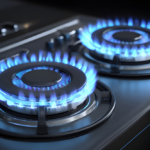
| A kitchen containing a gas cooker but no other fixed combustion appliance | The gas cooker alone does not trigger this CO-alarm requirement. |
The cooker exception does not exempt a kitchen that also contains a gas boiler. Oxford City Council’s summary of the England requirements also identifies boilers and wood-burning appliances as examples.
Choose equipment for the building and its occupants, and follow the manufacturer’s installation instructions. Consider accessibility: some residents may need alerts using vibration or flashing lights. The official guidance covers alarm selection and residents’ needs. Avoid treating one generic placement diagram as suitable for every device or property.
What must I check when a new tenancy starts?
The landlord, or someone acting on their behalf, must check that each required alarm works on the day a new tenancy begins. For this purpose, the start day is when the tenant is entitled to possession under the tenancy, which may differ from when they physically move in. See regulation 4(1)(b) and 4(3).
Arrange this as a specific handover task. Know who will carry out the checks and how they will record the result. Follow the device manufacturer’s testing instructions and give the tenant clear instructions for later testing and reporting problems.
The government guidance says landlords should keep a record of testing and suggests a signed inventory as one possible record. A signature supports the record; it does not replace the check.
“New tenancy” has a specific legal definition, so do not assume every continuation or replacement agreement triggers the same requirement. If that distinction matters to your arrangement, check regulation 4 and obtain advice. Tenancy-definition amendments took effect for private assured tenancies on 1 May 2026; they are set out in regulations 1 and 11 of SI 2026/325.
What should I do when a tenant reports a faulty alarm?
Where a tenant, or their nominated representative, reports a problem, the landlord must establish whether the required alarm works. If it is faulty, it must be repaired or replaced. Both investigation and any necessary repair or replacement must happen as soon as reasonably practicable. That timing is specified in the 2022 amendments; it is not a universal allowance of a fixed number of days.
The following is a practical follow-up routine, rather than a statutory form:
- Record the report. Note when it arrived, the property, the alarm’s location and what the tenant described.
- Identify the action needed. Arrange investigation without treating the issue as something that can simply wait for the next routine inspection.
- Arrange access and the work. Confirm who is attending and keep the tenant informed.
- Record the outcome. Note the finding, work completed and confirmation that the alarm works. Keep appropriate supporting evidence.
- Close the job when resolved. A booking confirmation alone does not show that the fault has been fixed.
For example, “upstairs alarm does not respond to its test button” is more useful than “alarm issue”. It helps identify the device and the task. A photograph may help locate it, but does not establish that it works.
Use our guide to planning property inspections and follow-up for wider maintenance organisation. A maintenance portal is not an emergency service: a sounding alarm or suspected danger should not be treated as an ordinary repair ticket.
What records help me keep track?
Use a consistent record for each property. Suggested fields are:
- Alarm type and exact location.
- Installation information and manufacturer’s instructions.
- Check date, person carrying it out and result.
- Fault report date and description.
- Investigation, repair or replacement arranged.
- Completion date, result and supporting documents.
These are suggested administrative fields, not a prescribed certificate or proof of compliance by themselves. They help distinguish completed work from outstanding action.
Keep records for an appropriate purpose and period rather than assuming that every alarm record has the same retention deadline. Our guide to keeping tenancy records explains the wider records-management questions.
Common questions
Who replaces the batteries?
The government guidance advises tenants to replace batteries when an alarm stops working during the tenancy. If it still does not work, or the tenant cannot replace the batteries, they should report it to the landlord. Landlords remain responsible for faulty alarms. Do not assume every device has user-replaceable batteries or every resident can carry out the task.
How often should alarms be tested during the tenancy?
Follow the manufacturer’s testing instructions and share them with the tenant. The official guidance encourages regular testing; that advice is separate from the landlord’s tenancy-start check and reported-fault duty. Do not turn a chosen administrative reminder into a claim that the law imposes one universal testing interval.
Does a gas safety visit replace the tenancy-start alarm check?
Not automatically. The required alarms must be checked on the day the new tenancy begins. A gas safety visit on another date does not establish that this check happened. The government Q&A addresses this point directly. Keep your gas safety records and renewal arrangements alongside, but distinct from, alarm checks.
Do landlords need an annual alarm certificate?
These alarm regulations do not create a universal annual alarm-certificate requirement for every ordinary private rental. Keep evidence of the checks and work you actually carry out. Licensed properties and more complex fire-alarm systems may have additional requirements, so check those separately. See the alarm regulations with their 2022 amendments, and our overview of landlord certificates and safety records.
How can Propiva help organise the work?
Propiva is UK compliance software for self-managing landlords.
Tenants can submit maintenance requests with photos, with notifications to the landlord. Landlords can also create maintenance jobs and update their status so tenants can see progress. These functions can help you keep track of reported work and what still needs attention.
You remain responsible for arranging the investigation and any necessary repair. A recorded request or status update does not by itself establish that an alarm is safe or that a legal duty has been met.
Sign up free to start organising your property records. One-property use is free, with upgrades available when adding further properties.
Disclaimer: This guide is provided for general information only and does not constitute legal, financial or professional advice. Rules and requirements may vary depending on your location and circumstances and can change over time. Always check current official guidance and seek professional advice where appropriate.